Search Epithalon benefits and you get the same list everywhere. Longer telomeres. Deeper sleep. A 28 percent drop in deaths. Those findings are real. Most of them were not measured on Epithalon.
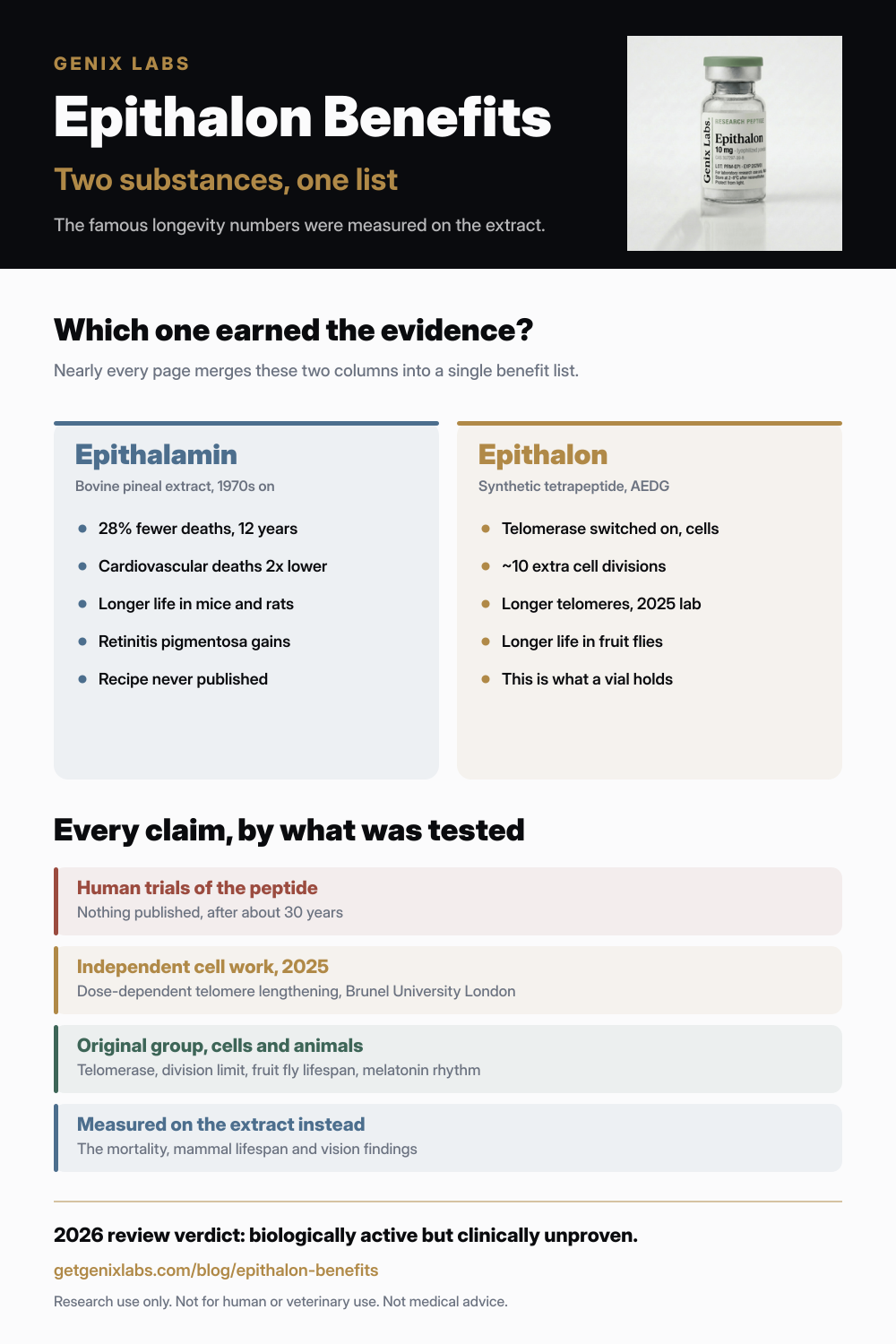
There are two substances in this story. One is Epithalamin, a ground-up extract of bovine pineal gland. The other is Epithalon, a synthetic peptide of four amino acids. The extract carries almost the entire human record. The peptide is what ships in a vial.
Nobody separates them. So this page does. Every claim below is graded by what was actually tested, on what, and by whom. Some of it is stronger than the sceptics admit. None of it is what the sales pages imply.
What are the benefits of Epithalon?
Epithalon is studied for telomere maintenance, sleep rhythm, antioxidant activity and immune markers. In cells it switches on telomerase and lengthens telomeres, including in one independent 2025 lab. In animals it extends life. No published trial has yet measured any of these benefits in people given the peptide itself.
- The 28 percent mortality figure came from Epithalamin, the gland extract, not the tetrapeptide.
- Telomere lengthening is now reported by an independent lab, not only the original group.
- That same 2025 paper found telomeres growing in cancer cells too, by a different route.
- A 2026 review calls the molecule biologically active but clinically unproven.
- There is no human study of the peptide measuring telomere length, lifespan or sleep.
Is Epithalon the same as Epithalamin?
No. Epithalamin is an extract of bovine pineal gland. It is gland tissue, ground up and prepared, holding many peptides whose exact mixture was never published. Epithalon is one synthetic peptide, four amino acids long. The extract came first, in the 1970s. The peptide was designed later to copy it.
This matters more than any other fact on this page. When a vendor cites a 12 year human study, that study used the extract. When the same page sells you a vial, the vial holds the peptide. The two are related. They are not interchangeable.
The 2026 review in the International Journal of Molecular Sciences makes the same split. It treats Epithalamin as historical background only, and reviews the synthetic peptide separately. The researchers drew the line. The sales pages rubbed it out.
What exactly was in the extract?
Not fully known, and that is the second problem with the famous numbers. Epithalamin was made by extracting peptides from cattle pineal glands. The result is a mixture. The full composition was never published, so the active ingredient was never isolated or confirmed.
That creates a gap nobody can close retrospectively. If the mixture worked, we do not know which part of it did. The tetrapeptide was chosen as the likely candidate and synthesised. It was a reasonable bet. It was still a bet.
Batch to batch variation is the other issue. An extract from animal tissue is only as consistent as the tissue and the process. A synthetic peptide can be made to the same specification every time, which is the one clear advantage the modern molecule has over the one with the better data.
Which Epithalon benefits actually have proof?
Sorted by what was tested, the list changes shape. The top floor, human trials of the peptide, is empty. The strongest human numbers sit on the bottom floor, because they belong to the extract. In between is cell and animal work, and one 2025 paper that changed the picture.
Read that drawing once and the whole topic simplifies. Nothing here is fake. The problem is that four floors of evidence get printed as one flat bullet list, and a bullet list makes a dish result look like a result in a person.
What is Epithalon?
Epithalon is a synthetic peptide built from four amino acids. The sequence is alanine, glutamic acid, aspartic acid, glycine. Chemists shorten that to AEDG. A peptide is simply a short chain of amino acids, the same building blocks proteins are made from.
Four amino acids is very short. Insulin has 51. That shortness is part of why the molecule is debated. It is hard to explain how so small a chain reaches the inside of a cell and changes which genes are read.
Why does the pineal gland matter here?
The pineal gland is a small gland in the brain. It makes melatonin, the hormone that tells your body when it is night. As people age, the gland makes less melatonin, and sleep gets lighter and more broken.
That decline is the idea behind both substances. If the gland fades with age, the thinking went, then something from the gland might slow the fading. Epithalamin was made from the gland itself. Epithalon was made to copy its active part.
It is a reasonable hypothesis. It is also forty years old, and still mostly a hypothesis. The pineal gland does decline with age. Whether putting a peptide back in reverses anything measurable in a person has not been shown.
What is a telomere, in plain words?
A telomere is a cap on the end of a chromosome. Chromosomes are the bundles that hold your DNA. Every time a cell divides, the caps get a little shorter. When they get too short, the cell stops dividing. That is one of the ways bodies age.
Telomerase is the enzyme that rebuilds the caps. Most adult cells switch it off. Stem cells keep it on, and so do most cancer cells, which is why they can divide without limit. So telomerase is useful and risky at the same time.
Hold that last sentence. It explains why a molecule that switches telomerase on is interesting to ageing researchers and watched carefully by cancer researchers. Both reactions are correct. They are reacting to the same mechanism.
Why telomere length is a marker, not a verdict
Short telomeres travel with age, illness and stress. That makes length a useful signal. It does not make length a cause. Lengthening a marker does not automatically improve the thing the marker points at.
This is the trap in every telomere product. Changing a number that correlates with health is not the same as changing health. Until someone measures an outcome, a longer telomere is a longer telomere.
What counts as a benefit, and what does not?
Research separates markers from outcomes. A marker is something measured in blood or in a cell, like telomere length or a cytokine level. An outcome is something that happened to a living thing, like sleeping longer, seeing better or living longer. Almost every Epithalon benefit claim is a marker.
The distinction is not pedantry. Medicine is full of markers that moved while outcomes did not. Drugs have raised good cholesterol without preventing a single heart attack. A marker is a promise that an outcome might follow, and the promise is often broken.
| Epithalon claim | Marker or outcome? | Measured in |
|---|---|---|
| Telomerase switched on | Marker | Human cells, in a dish |
| Telomeres lengthened | Marker | Human cells, two independent labs |
| Ten extra cell divisions | Outcome, for a cell | Human cell cultures |
| Longer life in flies | Outcome | Drosophila |
| 28 percent fewer deaths | Outcome | People, given the extract |
| Better sleep | Outcome | Never measured, in anything |
Only two rows in that table are human outcomes, and one of them was not the peptide. That table is the most useful thing on this page. It is also the thing no competing page prints.
Does Epithalon increase telomerase?
In cells, yes, and this is the best supported claim it has. Telomerase is the enzyme that rebuilds telomeres, the protective caps on the ends of your chromosomes. A 2003 paper reported Epithalon switching telomerase back on in human cells that had none. That finding has since been repeated independently.
The original work came from Khavinson and colleagues in St Petersburg. They used human fetal fibroblasts, a standard lab cell type that normally has no telomerase activity at all. After treatment, the cells expressed hTERT, the catalytic part of telomerase, and telomerase activity became detectable.
Two honest limits. The published abstracts did not give concentrations, sample sizes or statistics. And for twenty years, nearly every telomerase finding traced back to the same group. That second limit is the one that changed in 2025.
Did cells really divide more times?
A 2004 follow-up reported about ten extra divisions in treated human cell cultures. Normal human cells stop dividing after a set number of rounds, called the Hayflick limit. Pushing past it is a genuinely striking result, which is exactly why it needs repeating by other labs.
Ten extra divisions is not immortality. It is a measurable extension of a cell line's working life in a dish. The honest reading is that something happened to those cultures. The unhonest reading is that your body will do the same thing.
What did the independent 2025 study find?
A team at Brunel University London tested Epitalon on normal human cells and on two breast cancer cell lines. In the normal cells, telomeres got longer as the dose rose, with more hTERT messenger RNA and more telomerase activity. It is the first telomere result from a lab with no link to the original group.
This is the most important Epithalon paper in twenty years, and almost no page about benefits mentions it. The standard criticism of this molecule was that one group produced all the evidence. That criticism is now weaker than it was.
What the same paper found in cancer cells
In the two cancer lines, 21NT and BT474, telomeres also lengthened. They did it by a different route, called alternative lengthening of telomeres, or ALT. Normal cells showed only a small rise in ALT activity. So the peptide lengthened telomeres in both cell types, by two different mechanisms.
Nobody should read that as evidence of harm. It is a dish result in two cancer lines. But telomere maintenance is one of the things cancer cells need, and the finding sits in the same paper people cite for the good news. Quoting half of a paper is not citing it.
The correction nobody mentions
That 2025 paper carries a published correction, issued in November 2025. The correction notice does not state what was changed. It is not a retraction, and the findings stand as corrected. It is simply a thing an honest summary tells you, so you can read the current version rather than the first one.
What did the 2022 oocyte study add?
A Chinese group reported in 2022 that Epitalon protected mouse eggs from post-ovulatory ageing damage, in a dish. Eggs deteriorate quickly if they are not fertilised after release. The treated eggs held up better. It was the first independent Epitalon paper, three years before the telomere replication.
It matters for provenance more than for benefits. Nobody buys this peptide for egg quality. What the study showed is that a lab outside St Petersburg could take the molecule, run its own design, and get a positive result on something.
Two independent papers, in 2022 and 2025, on two unrelated questions. That is a thin but real foundation. It is also the reason the blanket dismissal of this molecule has stopped being accurate.
Why telomere results disagree between labs
Because telomere length is measured in several ways, and the ways do not agree. This is a known problem across the whole field, not an Epithalon problem. It is worth understanding, because it tells you how much weight a single telomere number can carry.
- qPCR gives an average ratio across all cells. It is cheap, fast, and the least precise.
- Terminal restriction fragment analysis measures actual lengths. It is slower and needs more material.
- Flow-FISH measures cell by cell, so it catches differences qPCR averages away.
- Different methods on the same sample can disagree by a wide margin.
So when a study reports longer telomeres, the method matters as much as the result. A dose-dependent rise, meaning more peptide produced more change, is stronger evidence than a single before and after reading. The 2025 paper reported a dose-dependent effect, which is a point in its favour.
This is also why no honest page should report a telomere percentage without the method behind it. If a vendor quotes a precise number with no method named, they are quoting a quote.
Does Epithalon lengthen telomeres in people?
Unknown. No published study has measured telomere length in people given Epithalon. Every telomere result comes from cells in a dish. The 2026 review states plainly that no adequately powered randomised trial has established efficacy for anything. Telomere length in humans is not an exception to that.
This is the single widest gap between what is sold and what is known. The telomere story is the reason most people look this molecule up. In cells it is real and now independently repeated. In people it has never been measured.
It would not even be a hard study to run. Telomere length is measurable in a blood sample. That such a study does not exist, after thirty years, tells you something about how this field has been funded.
Does Epithalon activate telomerase in humans?
Not shown. Telomerase activation has only been measured in cultured human cells, first by the original group and then independently in 2025. No study has taken blood or tissue from a person given Epithalon and measured telomerase activity. Cells in a dish are human cells, but they are not a human.
The distinction is easy to lose, because papers say human cells and readers hear humans. A cultured cell has no liver breaking the molecule down, no bloodstream diluting it, and no immune system reacting to it. It sits in a dish at a concentration the researcher chose.
That is why pharmacokinetics matters so much here. Until someone measures what reaches a cell inside a body, nobody knows whether the concentrations used in those dishes are reachable at all.
What does the human longevity data actually show?
One elderly cohort, one extract, one research group, measured decades ago. The treated patients died less often over twelve years. That is the entire human longevity record, and it belongs to Epithalamin. For the tetrapeptide, the human longevity record is empty.
It would be unfair to dismiss the cohort result. Twelve years of follow-up is serious work, and the effect size was large. It would be equally unfair to present it as settled. Unreplicated, loosely allocated, and on a different substance are three real caveats, and they all apply at once.
Where does the 28 percent figure come from?
From a 12 year study in elderly patients with coronary heart disease, using Epithalamin, the gland extract. The treated group had about 28 percent fewer deaths than controls on the same basic therapy. Cardiovascular deaths were roughly two-fold lower. The substance tested was the extract, not the tetrapeptide.
That is a large effect over a long follow-up, and it deserves to be taken seriously. It also comes with real caveats. It came from one Russian research group. Descriptions of the design vary between sources. Allocation and blinding were not what a modern trial would require.
A separate three year study reported lower mortality in 39 treated coronary patients against 40 controls. Same group, same extract, small numbers. No independent team has reproduced either result, and no Western randomised trial has been completed.
Does Epithalon increase lifespan?
In animals, published work says yes, and the split between substances shows up here too. The extract was reported to extend life in fruit flies, mice and rats, in a 1998 paper. The peptide has its own fruit fly result, from 2000. There is no mammal lifespan study of the peptide alone.
Fruit flies are a real model for ageing research, and they are not mice. A molecule that extends fly lifespan has cleared a low bar. Many things extend fly lifespan. Far fewer survive the move to mammals, and fewer still to people.
So the honest sentence is this. The extract has mammal lifespan data. The peptide has insect lifespan data. Pages that say Epithalon extends lifespan in mammals are quoting the extract and naming the peptide.
What did the fruit fly studies actually measure?
Average and maximum lifespan in populations of flies. Researchers raise large groups, treat some, and record when each one dies. The treated groups lived longer on average. It is a clean, cheap design and a genuinely standard first test in ageing research.
The limits are built into the model. A fly lives about two months. It has no pineal gland, no melatonin system like ours, and a very different immune system. So a fly result cannot tell you the mechanism works the way the pineal story says it does.
Flies are a filter, not a proof. Many compounds extend fly lifespan and then do nothing in mice. The useful reading is that Epithalon passed the first filter. Nobody has published whether it passes the second.
What about all the positive user reports?
They are real reports and they are weak evidence, for reasons that have nothing to do with honesty. People who buy a longevity peptide expect to feel better, start other habits at the same time, and notice what they are watching for. Those three things alone produce reports.
- Expectation changes what people notice, especially for sleep and energy.
- People start a peptide alongside better sleep habits, training or supplements.
- Nobody posts about the cycle where nothing happened, so the record skews positive.
- Wearable scores drift with routine, travel, alcohol and season, not just molecules.
- Without a control group, there is nothing to compare the experience against.
None of this means reports are worthless. They are how researchers decide what to study next. They are just not a substitute for the study, and for this peptide the study is what is missing.
Does Epithalon improve sleep?
Possibly, but not provably. Reviews report that it influences melatonin production and circadian rhythm, mostly from animal and cell work. No published trial has measured sleep quality in people taking Epithalon. The sleep reputation is built on mechanism plus user reports, not on sleep studies.
The mechanism is at least coherent. The pineal gland makes melatonin. Melatonin times sleep. A pineal peptide that nudges melatonin would plausibly affect sleep. Coherent is not the same as demonstrated.
Sleep is also the claim most vulnerable to expectation. People who buy a sleep peptide watch their sleep closely, and sleep responds to attention and routine. A wearable showing better deep sleep after a change cannot separate the molecule from the behaviour around it. For what the evidence supports across this whole category, see our ranking of peptides for sleep.
Is Epithalon better than melatonin?
For sleep timing, melatonin has incomparably more human evidence. It has been tested in hundreds of trials, at known doses, with known effects on sleep onset and jet lag. Epithalon has no human sleep trial. On evidence alone, this is not a close comparison.
The claimed difference is in kind, not strength. Melatonin supplies the hormone directly. Epithalon is studied for whether the gland makes its own melatonin better. If that proved true in people, it would be a different and more interesting effect. It has not been shown in people.
Does Epithalon help retinitis pigmentosa?
An older controlled study reported vision gains in retinitis pigmentosa, a genetic eye disease that slowly destroys the retina. The 2026 review counts it among the few pieces of human evidence that exist. It used the extract preparation and has not been independently repeated.
It is cited more often than its size deserves, because it is one of very few human studies in the whole literature. One unreplicated study in a rare disease is a reason to run another study. It is not a benefit to expect.
What about the antioxidant claims?
Reviews report antioxidant and antimutagenic activity, measured mostly in animals and cells. Oxidative stress is damage from reactive molecules that build up as cells work. Reducing it in a dish is common. Translating that into a benefit you would notice is rare.
Treat antioxidant findings as mechanism, not outcome. They help explain why researchers keep studying the molecule. They do not tell you anything will feel different.
Does Epithalon boost the immune system?
Reviews report changes in interleukin-2 messenger RNA and in mouse thymocyte activity. The thymus is the gland that trains immune cells, and it shrinks with age. Those are marker-level findings in animals and cells. No human immune outcome has been published.
Immune markers moving is not the same as fewer infections. The gap between a shifted cytokine level and a person who gets sick less often is the gap this whole field has never crossed.
What is the gene expression claim?
A 2003 paper reported that short regulatory peptides affect gene transcription, meaning which genes get read and turned into protein. Reviews also note effects on enzymes including acetylcholinesterase, butyrylcholinesterase and telomerase. These are cell and in silico findings, meaning dish work and computer modelling.
One review is candid that the physicochemical and structural work on this peptide remains limited, and that the listed mechanisms may not be the only ones. In plain terms, after thirty years nobody is certain how a four amino acid chain would do any of this.
How could four amino acids do any of this?
Nobody has shown exactly how. That is the honest state of the mechanism, and it is the strongest argument the sceptics have. To change which genes a cell reads, a molecule normally has to get inside the cell and reach the DNA. Four amino acids is a very small key for that lock.
The proposed explanation is that short peptides can enter cells and bind directly to stretches of DNA, nudging transcription. Modelling work supports that it is physically possible. Possible is not the same as demonstrated in a living cell, and one 2025 review says the structural work here remains limited.
Why does this matter to a benefit list? Because an unexplained mechanism makes every downstream claim less predictable. If you do not know how a thing works, you cannot guess what else it does. That is the cautious reading, and it is the right one.
Does Epithalon do anything for skin or hair?
No published study has measured skin or hair outcomes with Epithalon. The claim comes from a chain of reasoning, not a result. Cells age, telomeres shorten, skin shows age, therefore a telomere peptide should help skin. Each step is plausible and none of them was measured.
Compare that to a copper peptide, where twelve week facial cream trials actually measured fine lines and collagen on people. That is what a skin claim with evidence looks like. Our grading of GHK-Cu benefits walks through which of those held up.
So if skin is the goal, Epithalon is the wrong place to start. Its interest is internal and mechanistic. Nothing about it has been pointed at a mirror.
What does the newest review conclude?
A 2026 narrative review in the International Journal of Molecular Sciences summarises it in four words. Biologically active but clinically unproven. The authors find real activity across telomere maintenance, circadian function, oxidative stress and ageing markers, and no adequately powered randomised trial of any clinical benefit.
They also flag what is missing beyond efficacy. Pharmacokinetic data, meaning what the body does with the molecule, is inadequate. So is dose-ranging work and long-term safety data. Oncologic, immunogenicity, product quality and regulatory questions remain open after a 2026 FDA advisory review.
That is a fair verdict and a useful one. It refuses both easy stories. The molecule is not inert and it is not proven. Anyone selling you either of those two sentences is simplifying a review they probably have not read.
- An adequately powered randomised trial of any clinical benefit.
- Pharmacokinetics: what the body actually does with the peptide.
- Dose-ranging work, so an amount could be chosen on evidence.
- Long-term safety data, including oncologic and immune questions.
- Product quality standards, which is a supply problem as much as a science one.
Is it still all one research group?
Less than it was, and that is new. For about twenty years the honest criticism was that the St Petersburg group produced nearly every finding. Since 2022 there are independent papers, including a 2022 mouse oocyte study and the 2025 Brunel telomere work. The core human claims are still unreplicated.
Why does provenance matter so much? Because replication is how science checks itself. A finding from one group is a hypothesis. The same finding from a lab with no stake in it becomes a fact. Epithalon has just started crossing that line, in cells.
The record, counted
Search the literature and the shape is clear. The telomerase paper, the division limit paper, the gene transcription paper and the fly lifespan paper all share the same senior author. The extract's mortality and lifespan studies share an overlapping group. The two independent papers are recent and both are in cells or eggs.
One more pattern is worth naming. Several of the key papers appeared in the same journal, as short reports, without the concentrations and statistics a reader needs to judge them. That is not fraud. It is a publishing style that makes replication harder, which is part of why replication took twenty years.
If you read a page claiming all Epithalon evidence is Russian and therefore worthless, it is out of date. If you read a page claiming the telomere effect is established in humans, it is wrong. The truth moved, and it moved in cells.
Does Epithalon reverse aging?
No published evidence says it does in people. Ageing was not measured as an outcome in any human study of the peptide. The extract has mortality data in one elderly cohort, which is a different and narrower claim. Reversing ageing is a marketing sentence, not a finding.
Even the strongest result does not support it. Longer telomeres in a dish is a change in one marker of cell ageing. Telomere length is a marker, not a verdict. Plenty of things shorten or lengthen telomeres without changing how long anything lives.
The careful version is worth more than the dramatic one. This is a molecule with real activity on one ageing pathway, measured in cells, now by two independent labs. That is genuinely interesting. It is not a reversal of anything.
How long does Epithalon take to work?
There is no evidence-based answer, because no human study has measured any benefit over time. The cycle lengths quoted online come from community practice, not from trials. Cell studies ran over days to weeks. The 12 year extract study measured deaths, which tells you nothing about when anything starts.
Be sceptical of any page giving you a confident timeline. A timeline requires a study that measured an outcome at several points. For this peptide, in people, that study does not exist.
What amounts were used in the research?
The published record is thin and inconsistent. Many abstracts never printed concentrations at all, which is one of the field's real weaknesses. The 2026 review lists dose-ranging as missing data. That is why no standard protocol exists for this molecule anywhere in the literature.
We do not publish human dosing, and nothing here is a protocol. For what the studies themselves reported, and how to read those figures as a research record rather than instructions, see Epitalon dosage: what the studies actually used.
Can Epithalon be taken orally?
Oral delivery of a peptide is the hard problem in this whole field. Stomach acid and gut enzymes break peptide chains apart before they reach the bloodstream. Research has mostly used injected or intranasal routes for this reason. No comparison of routes in people has been published.
Oral sprays and capsules are sold anyway. Without pharmacokinetic data, meaning measurements of what actually reaches the blood, there is no way to know whether an oral product delivers anything at all. The 2026 review lists exactly that data as inadequate.
What are the side effects?
Reported side effects are mild and few, but the reason is uncomfortable. Nobody has run a safety study of the peptide in people. A short list of side effects from no trials is not the same as a short list from large trials. The 2026 review calls long-term safety data inadequate.
We cover the full picture, including what the absence of data does and does not imply, in Epithalon side effects: the list with no study behind it.
The cancer question, stated fairly
People ask whether telomerase activation could feed cancer, and it is a sensible question. Cancer cells need telomere maintenance to keep dividing. The 2025 independent paper did find telomeres lengthening in two breast cancer lines, by the ALT route rather than telomerase.
No study shows Epithalon causing or accelerating cancer in an animal or a person. No study rules it out either. The 2026 review lists oncologic questions as open after an FDA advisory review. Open means open, in both directions.
Is Epithalon FDA approved or legal?
It is not approved by the FDA for any use, and it is not a licensed medicine anywhere we know of. It is sold legally as a research chemical for laboratory use, which is a different legal category from a medicine. A 2026 FDA advisory review left regulatory questions open.
Research-use-only is not a loophole or a wink. It is the actual status. Everything Genix Labs supplies is for in-vitro laboratory research only, and that is the basis on which it is sold. For how this works in Indonesia specifically, see are peptides legal in Indonesia.
Is it legal to buy in the United States?
Research chemicals are generally sold lawfully in the United States when they are labelled and supplied for laboratory research only. What is not lawful is marketing one as a treatment, or selling it for human use. The 2026 FDA advisory review is a signal that this boundary is being looked at more closely.
Rules differ by country and they change. Anyone ordering across a border is responsible for their own jurisdiction's import rules. We ship research-use-only and document it as such.
Epithalon, Epitalon or Epithalone?
All three are the same molecule. Epithalon and Epitalon are the two common spellings, and Epithalone appears occasionally. The difference is transliteration from Russian, not chemistry. Chemists avoid the whole problem by writing AEDG, after the four amino acids.
Epithalamin is the one name that means something different. It is the bovine pineal extract. The similarity in spelling is the root of the confusion this page exists to clear up.
Practical tip when reading a study. Check which word the abstract uses, then check what the methods section actually administered. A paper titled with one name sometimes tests the other, especially in older translated work.
Why do pages merge the two substances?
Partly carelessness, partly incentive. The extract has the impressive human numbers. The peptide is what can be synthesised, shipped and sold. Merging them gives a sellable product the credibility of a twelve year mortality study it was never part of.
There is an innocent version too. The peptide was designed to copy the extract's active fragment, so treating them as one thing feels reasonable. The problem is that the copy has never been tested against the original in a person. Assuming they match is an assumption, not a finding.
Our own position is the boring one. We sell the tetrapeptide, we describe the tetrapeptide's evidence, and we tell you the famous numbers belong to something else. That is less exciting and it is what the literature supports.
Who should avoid Epithalon?
This is a research chemical, so the honest framing is who should not be handling it at all. It is supplied for in-vitro laboratory work only, not for human or veterinary use. There is no approved human use from which an exclusion list could be drawn.
What the literature does flag is where the unknowns concentrate. The 2026 review lists oncologic and immunogenicity questions as open, and long-term safety data as inadequate. A molecule that acts on telomere maintenance is one where those open questions are the whole point, not a footnote.
How does it compare to other longevity peptides?
Badly, on evidence, and that is worth knowing before you choose. Several compounds in the same category have human trial data of some kind. Epithalon the peptide has none. Its distinction is mechanistic novelty, not evidential strength.
| Compound | Best human evidence | What it is studied for | Evidence floor |
|---|---|---|---|
| Epithalon | None for the peptide | Telomere maintenance, sleep rhythm | Cells and animals only |
| GHK-Cu | Facial cream trials, 12 weeks | Collagen, fine lines, skin tone | Human, topical route only |
| NAD+ | Small human biomarker studies | Cellular energy, NAD levels | Human, modest and mixed |
| MOTS-c | Early human work, split results | Metabolic and exercise signalling | Human, inconsistent |
| Glutathione | Human studies, several routes | Antioxidant status, skin tone | Human, route dependent |
Read that table as a ranking of certainty, not of interest. Epithalon sits at the bottom for evidence and near the top for mechanistic curiosity. Those are different axes, and conflating them is how people end up disappointed. Start at the longevity and anti-aging peptide hub to see how the rest of the category compares.
What does a real evidence base look like?
It helps to see the contrast. Compare Epithalon to a compound class with a finished evidence base, like the GLP-1 receptor agonists studied for weight. Not because they do the same thing, but because the difference shows what proven actually means.
| What exists | GLP-1 class | Epithalon, the peptide |
|---|---|---|
| Randomised human trials | Dozens, thousands of participants | None |
| Pre-registered endpoints | Yes, weight and metabolic outcomes | No |
| Dose-ranging studies | Yes, phase by phase | Listed as missing in 2026 |
| Pharmacokinetic data | Yes, by route | Listed as inadequate in 2026 |
| Independent replication | Across many countries | Two papers, 2022 and 2025, in cells |
| Long-term safety follow-up | Years, with registries | None |
That right-hand column is not an insult. It is the normal state of a research compound. Almost everything in a laboratory catalogue looks like that, which is exactly why it is sold for research. The problem is only ever pages that describe the right column in the language of the left one.
If you want the other end of this spectrum in our own range, our weight and metabolism peptide hub covers the compounds that do have human trial data behind them.
Three questions to ask any Epithalon page
You do not need a biology degree to audit a page about this molecule. Three questions catch nearly every error on the first screen. We hold this page to them too.
- Which substance was tested, the extract or the tetrapeptide? If the page never says, assume it does not know.
- What was it tested in, a dish, a fly, a mouse or a person? Benefits in a dish are not benefits.
- Who ran the study, and has anyone else repeated it? One group is a hypothesis, two is a finding.
Run those three against the usual benefit list and most of it resolves instantly. The 28 percent figure fails question one. The telomere story passes question three now, and still fails question two for humans.
How do you know a vial holds the real peptide?
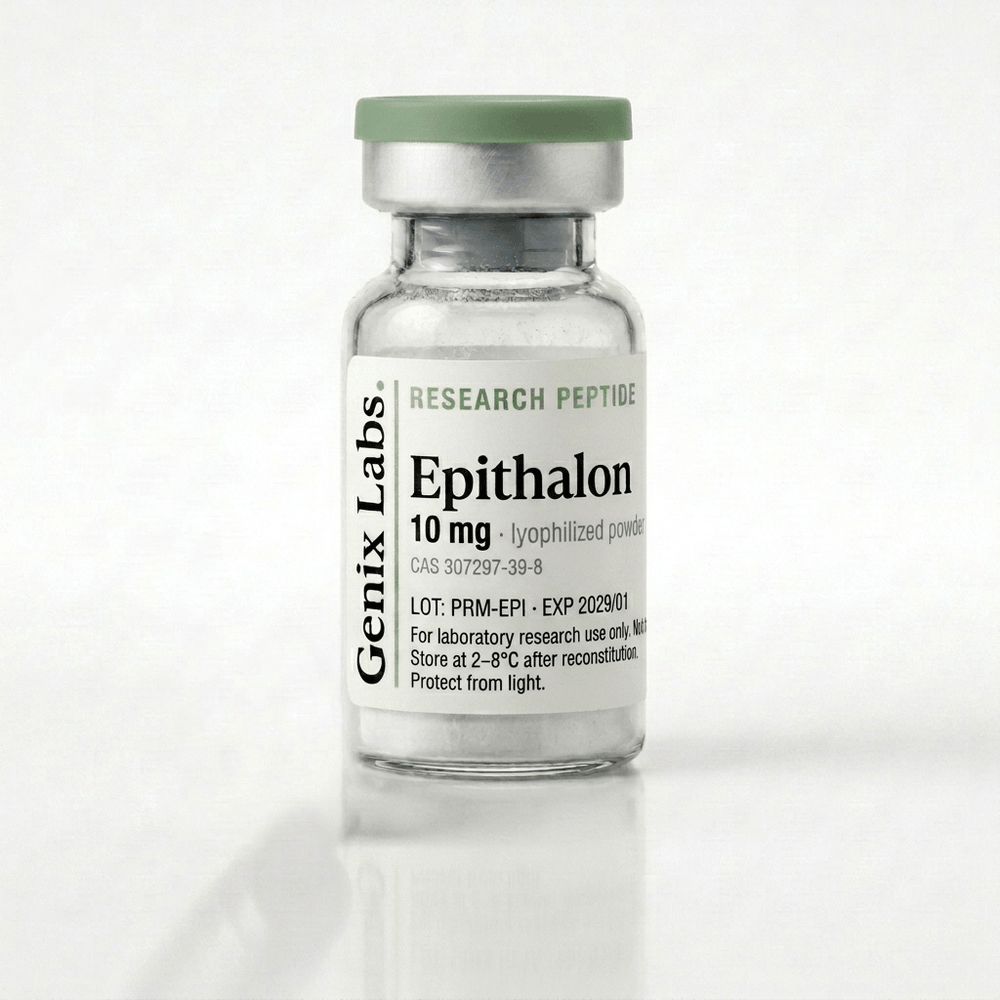
You read the lot document, not the label. A four amino acid peptide is cheap to fake and hard to eyeball. Two tests matter. HPLC separates what is in the vial and reports purity. LC-MS weighs the molecule and confirms it is the right one.
Identity is the test people skip, and it is the one that catches a wrong peptide. Purity alone tells you the contents are consistent. It does not tell you they are AEDG. Both numbers should be tied to a printed lot number you can match to the vial in your hand.
Our published lot for Epithalon 10mg reports HPLC area purity of 99.40 percent with LC-MS identity confirmation, on lot 489053, tested to ISO 17025. One honest caveat on reading any such figure. HPLC area percent is a purity measure, not a content measure, and it is not a statement about sterility, safety or efficacy. It applies only to the lot printed on it.
- A lot number on the document that matches the vial.
- HPLC area purity, read as purity and not as content.
- LC-MS identity, which is what confirms the molecule is AEDG.
- An ISO 17025 accredited lab behind the testing.
- Cold-chain handling on the way to you, since a peptide is a perishable.
Why handling decides whether anything is left
A tetrapeptide arrives as a freeze-dried powder, which is stable while it stays cold and dry. Heat, light and moisture are what degrade it. In a tropical climate that is not a theoretical risk, it is the default condition outside a fridge.
The sealed vial should stay cold and out of light. Once a powder is reconstituted, it becomes a liquid with a much shorter working life, and it stays refrigerated. Our guides to reconstituting peptides cleanly and to storing peptides in Bali's heat cover the practical side.
This matters for benefits specifically. A degraded vial produces no effect for reasons that have nothing to do with the molecule's biology. Plenty of people concluding a peptide did nothing were testing a peptide that was already gone.
What would upgrade any of these claims?
It helps to know what you are waiting for. Each claim below has a specific study that would move it up a floor. None of these are exotic designs. They are ordinary studies that have not been funded.
| Claim today | What would upgrade it | Why it has not happened |
|---|---|---|
| Telomeres lengthen, in cells | Telomere length measured in people, before and after | Cheap and simple, which makes the absence telling |
| Mortality fell 28 percent | The same trial run with the peptide, not the extract | Would take years, and nobody owns the molecule |
| Sleep improves | A sleep study with actigraphy or polysomnography | Standard design, never applied to this peptide |
| It is safe | A dose-ranging safety trial with long follow-up | Listed as inadequate by the 2026 review |
| It reaches the bloodstream orally | Basic pharmacokinetics by route | Also listed as inadequate, yet oral products are sold |
If a page never tells you what would change its mind, it is not reporting evidence. We will update this table when any of these appear.
Mistakes that waste a research cycle
- Reading an Epithalamin result as an Epithalon result. This is the big one, and it is on nearly every page.
- Quoting the 2025 telomere paper without its cancer-cell finding or its correction.
- Treating a telomere marker as a lifespan outcome. They are not the same measurement.
- Buying an oral product with no pharmacokinetic data behind the route.
- Reading HPLC area purity as content, or as a statement about safety.
- Letting a vial sit warm, then concluding the molecule does nothing.
Who is this molecule actually for?
Researchers studying telomere biology, pineal function or cell ageing. That is the honest answer, and it is the only use Genix Labs supplies it for. The cell evidence is now independently supported, which makes it a reasonable thing to study.
It is not for anyone expecting a measured human benefit, because no measured human benefit of the peptide exists. If that is what you want from a longevity compound, the comparison table above points to compounds with human data.
What does a vial cost?
Our lab-tested Epithalon vial is 49 US dollars for 10mg, or 850,000 rupiah. That is the lowest price point in our longevity range, which reflects how simple a four amino acid peptide is to make. Orders ship cold-packed and tracked, same-day in Bali with cash on delivery available.
Price is a weak signal of quality in this market, in both directions. The lot document is the signal. A cheap vial with published HPLC and LC-MS results on a matching lot number tells you more than an expensive vial with a nice label.
Is Epithalon worth studying at all?
On the evidence, yes, as a research subject, and no, as a shortcut to anything. The 2025 independent replication genuinely changed its standing. A result that survives a lab with no stake in it is worth more than twenty years of in-house papers.
What has not changed is the empty top floor. Thirty years in, there is still no human trial of the peptide measuring any benefit it is sold for. Both of those sentences are true at once, and any page giving you only one of them is selling something.
Frequently asked questions
What does Epitalon do?
In cells it switches on telomerase and lengthens telomeres, the protective caps on chromosomes. Reviews also report effects on melatonin rhythm, antioxidant activity and immune markers. All of that is cell and animal work. No published study has measured any of these effects in a person given the peptide.
Does Epitalon lengthen telomeres?
In cultured human cells, yes. An independent London lab reported dose-dependent lengthening in 2025, with more hTERT and telomerase activity, which repeated the original 2003 finding. In people it has never been measured, even though telomere length is testable from a blood sample.
Does Epitalon reverse aging?
No published evidence says so. Ageing was never an outcome in any human study of the peptide. The famous 28 percent drop in deaths came from Epithalamin, a bovine pineal extract, in one elderly cohort. Longer telomeres in a dish is a marker changing, not ageing reversing.
Does Epitalon improve sleep?
Possibly, but it has never been tested. Reviews report effects on melatonin production and circadian rhythm from animal and cell work, which makes the mechanism coherent. No trial has measured sleep quality in people taking Epithalon, so the reputation rests on mechanism and user reports.
How long does Epitalon take to work?
There is no evidence-based answer, because no human study measured any benefit over time. Cycle lengths quoted online come from community practice, not trials. A timeline needs a study measuring an outcome at several points, and for this peptide in people that study does not exist.
Is Epitalon FDA approved?
No. It is not approved for any use and is not a licensed medicine. It is supplied lawfully as a research chemical for laboratory work, which is a different category from a medicine. A 2026 FDA advisory review left oncologic, immunogenicity and regulatory questions open.
Takeaway
The Epithalon benefit list is not fiction. It is two substances' evidence printed under one name. Epithalamin, the gland extract, carries the 28 percent mortality figure, the mammal lifespan data and the vision study. Epithalon, the tetrapeptide in the vial, carries the cell work.
Within the cell work, something real happened in 2025. An independent lab in London reported dose-dependent telomere lengthening in normal human cells, with more hTERT and more telomerase activity. The same paper reported telomeres lengthening in two cancer lines by another route. Both halves belong in any honest summary.
Two sentences are worth carrying away. The strongest human numbers were never measured on the molecule being sold. And the best verdict available is still the 2026 review's four words, biologically active but clinically unproven. Start at the longevity and anti-aging peptide hub for the rest of this cluster, or read Epithalon explained for the plain introduction.
Genix Labs supplies all compounds strictly for in-vitro laboratory research. They are not for human or veterinary use, and nothing on this page is medical advice.